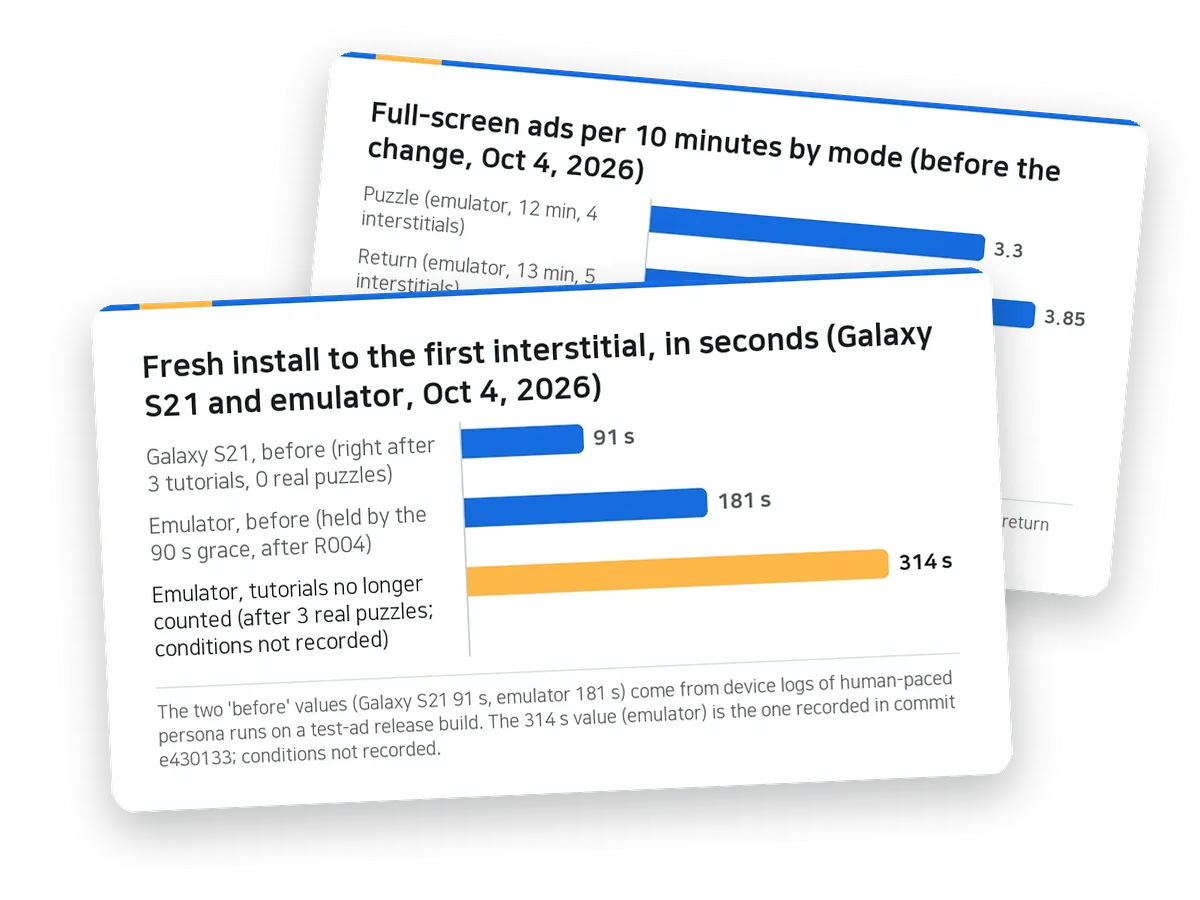
We set interstitial frequency from device timelines, and tutorials don't count
Once the three tutorial puzzles stopped counting toward ads, the first interstitial in puzzle mode moved to after the third real puzzle. We chose what to count by reading ad logs from fresh installs in time order.
Ads and metrics for two puzzle games 2/4
Free games earn from interstitials between rounds, but a new player who sees an ad before they understand the game tends to leave. So games add guard rules such as "no interstitial in the first three runs or the first 90 seconds". What those rules do in practice is hard to tell from the spec alone.
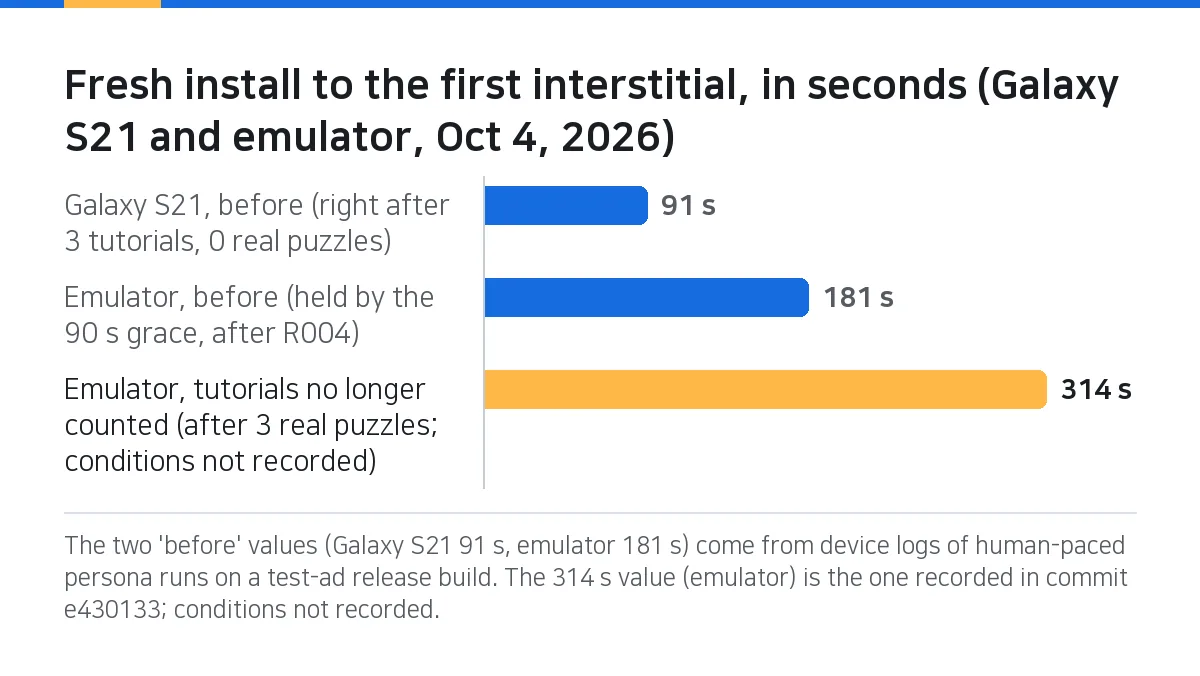
On October 4, 2026 we let a script play a fresh install of Block Turn at human pace on a Galaxy S21 and lined up the ad log by time. The first interstitial came 91 seconds after launch, before a single real puzzle: the three tutorial puzzles had already satisfied the three-run rule. Once tutorials stopped counting, the emulator's first interstitial moved from 181 s to 314 s, and the slower classic mode now counts a game over as two runs.
Contents (9)
- On a fresh install, the first interstitial came before any real puzzle
- The three tutorials had already met the 3-run gate
- Run length decided which rule set the pace
- Tutorials excluded, classic counted twice, a 6-run gate dropped
- The banner slot rule changed five times, between an empty strip and a shifting layout
- Block Turn launched without Firebase, so D1 and D7 went unmeasured at launch
- After pm clear, 12 to 15 minutes of logs, with S11 before S10
- The S21 and classic numbers after the change are still missing
- Frequently asked questions
On a fresh install, the first interstitial came before any real puzzle
Block Turn shows an interstitial only when a player taps Next, Play again or Home after a finished run. The numbers lived in one place in the code: at least 3 finished runs, 2 runs since the last interstitial, 90 s since the session started, 120 s since the previous full-screen ad, at most 5 per session and 20 per day, and only if an ad was already loaded. Here "full-screen ad" means interstitials, rewarded ads and app open ads together. The PRD (v2.1 §11.2) rules out an interstitial within the first three finished runs and the first 90 seconds of a session, and hides the banner on the tutorial puzzles and the first three runs.
Every run on October 4 started from cleared app data. The session script plays scripted runs, or personas, each with a fixed mode and pace range, and reads ad impressions from the SDK log. On the S21, the first interstitial came at 91 s, on Next after tutorial R003. The emulator finished the tutorials in 64 s; its first interstitial came after R004, at 181 s. Two other emulator personas (mixed and return) got their first one at 158 s and 134 s.
The three tutorials had already met the 3-run gate
The function that counted finished runs did not tell tutorials apart. In the first version of the app, written with the coding agent, the run-end function added every tutorial solve to the banner's run count and to the interstitial's win count, exactly like a real run. By the time the third tutorial ended, "3 finished runs" was already true.
Both the 3-run gate and the 90-second grace were meant to protect a new player. The three tutorials take 64 to 90 seconds, so the two guards opened at nearly the same time instead of adding up. The first ad's timing then depended on how fast the tutorials were cleared. The emulator met the 3-run gate at 64 s but was still inside the 90-second grace, so its ad waited for the next run, R004; on the S21 the grace was nearly over when R003 ended, so the ad came right after the tutorials.
The numbers came from documents. The monetization design for our other game in the same repository, Arrow Knots, cited industry advice to hold the first interstitial back from the session start and picked a 90-second grace; Block Turn's PRD wrote the same 90 s and passed it to the shared ad pacing module. The session script first arrived with the launch prep on October 4. Before it, the repository has no record of anyone looking at the first few minutes on a time axis.
A test written with the agent had locked the behavior in. The device E2E suite committed that morning checked "banner shown from R004" as a pass condition in scenario S1. Under the PRD, R004 is the first real puzzle and should have no banner. The first draft of the launch plan raised the tutorial problem from a simulation only, and the cross-check disputed it. Once the device logs came in, the ad plan marked the issue as confirmed by measurement.
Run length decided which rule set the pace
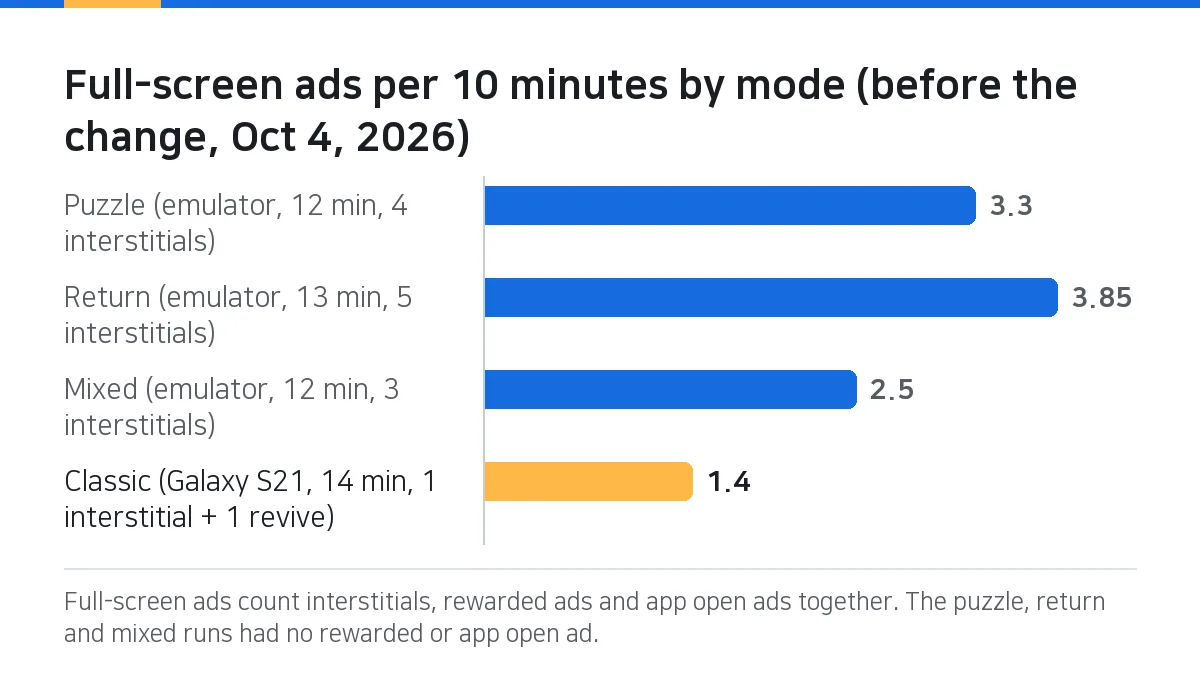
In a 12-minute run of the three-move puzzle persona on the emulator, interstitials appeared at 181, 322, 465 and 611 s: gaps of 141 to 146 s, or 3.3 per 10 minutes. A puzzle takes about a minute, so "every 2 runs" was always met first, and the 120-second gap was what held the pace.
Classic went the other way. In a 14-minute S21 session, tutorials included, classic produced 2 runs (150 moves); the ad plan puts a run at about five minutes. The only interstitial was the one right after the tutorials. Counting the one rewarded revive the script accepted, the session still had just 1.4 full-screen ads per 10 minutes. Two classic runs take about ten minutes, so in classic the every-2-runs gate, not the 120 s gap, set the pace.
The launch plan's revenue simulator assumed a 90-second classic run, while the comment on that same line quoted the classic supply experiment's human target of 4 to 10 minutes. It also kept each interstitial on screen for 15 s; the session script closed them after 5 to 8 s, like a person. Replaying the puzzle persona in the simulator gave 4.09 interstitials in 12 minutes, matching the 4 measured, but a median gap of 162 s against the measured 141 to 146 s. Running it again on November 1 gave 4.09 and 162 s.
Tutorials excluded, classic counted twice, a 6-run gate dropped
A commit on the evening of October 4 carries the operator's three frequency decisions (the fourth item in that list is the banner slot rule below). Its message files them as "user decisions, from device measurements". The store listing's ad notice was changed in the same commit to say there is no banner and no between-run ad on the tutorials and the first three runs.
- Tutorials no longer count toward the banner or the interstitial. In puzzle mode a new player sees neither before three real runs.
- A classic game over counts as two runs toward the interstitial: the code adds two wins. So in classic the interstitial can come from the second game over for a new player, then after every game over, while the banner still waits for three runs. The 120 s gap and the session and daily caps stay, and the ad plan estimated that classic players would go from 1.4 to about 2 per 10 minutes.
- No app open ad when the player returns in the middle of a run (a classic move made, or a puzzle piece placed and the puzzle not yet over).
fun onRunEnded(tutorial: Boolean = false, classic: Boolean = false) {
    if (tutorial) return
    runsEnded++
    prefs.edit().putInt(K_RUNS, runsEnded).apply()
    if (!enabled) return
    ads.onWin()
    if (classic) ads.onWin()
}
Raising the first-interstitial threshold from 3 runs to 6 would have been a one-constant change. The ad plan advised against it: once players who skip tutorials or abandon runs are in the mix, a raw count gives a grace of uneven length, so it recommended excluding tutorial solves instead. An interstitial after every run was ruled out because the 120 s gap already set the pace; only classic, with its long runs, moved to every game over. Removing the interstitial on the classic result screen's Home button was considered; the ad plan recommended keeping it, treating the break after a score screen as an allowed placement, and the code was left as is. The genre habit of an ad after every game over, as in Block Blast, was one input to the classic change.
When you set numbers meant to protect new players, leave tutorial levels out of the ad counters. Then check on a freshly installed device, from the log, at which second and after which run the first ad actually appears.
The banner slot rule changed five times, between an empty strip and a shifting layout
From October 3 to 5, each change fixed what the previous rule left behind, and the first one was made in the shared module before Block Turn existed.
| Time (KST) | Banner slot rule | What it left |
|---|---|---|
| Oct 3 16:38 | No space until ads may be requested (consent pending or refused) | Empty strip on an offline device with consent already stored |
| Oct 4 02:05 | Zero height until the first ad actually arrives | A late fill pushed the board down (S21 classic, y 416 to 620) |
| Oct 4 17:14 | Slot reserved up front | Offline empty strip (listed as a drawback in the ad plan) |
| Oct 4 19:07 | Reserved only after a banner has filled in this process | The first fill in each process pushed the HUD down and put the banner where the home chip was |
| Oct 5 12:52 | Reserved from the first frame on every screen; collapses only on a failed load | Offline, an empty strip shows briefly, then folds |
The last change lets the layout move only away from the ad: when the banner collapses, content moves up, and the ad never slides down onto the home and undo chips a finger is reaching for. The same commit stops reserving the slot and requesting ads after a failed load for 1, 2, 4 and up to 10 minutes, so the empty strip shows up less often.
Block Turn launched without Firebase, so D1 and D7 went unmeasured at launch
A device timeline shows when ads appear and how often, not whether players stay. Analytics arrived only on October 11, in version code 4, and there is still no remote config as of November 1. GA4 has tracked D1 since, but no one has compared it across the rule change yet. The ad plan gives PRD compliance and first impressions as the reasons for excluding tutorials, noting there is no number for how much retention would improve.
An app with remote config, analytics and enough players has a better basis: a 50/50 A/B test that changes frequency alone. Our PRD (§11.3) planned a 5% holdback of new players with no interstitials, but the ad plan dropped it because telling a 12% D7 from a 10% D7 at a 1:19 split would take about 42,000 installs; it plans a 50/50 single-variable A/B once there is scale. Without remote config, every frequency change in Block Turn needs an app update and a store review.
Each persona ran once, at a pace drawn from fixed ranges. That is not the spread of real player speeds, and the same rules already gave first ads at 91 s and 181 s. The builds used test ads, so fill rates may differ from live ads. The code shows an interstitial only when one is preloaded, so live counts can match these numbers or fall below them. What real players did in the first chapter is in Puzzle game day-one churn: the walls in chapter 1.
After pm clear, 12 to 15 minutes of logs, with S11 before S10
- Build with test ad IDs only. For a release build, keep minification on and keep only the ad and run-end log lines. Count the test and real IDs in the dex as in Why R8 kept 5 AdMob test IDs in a release AAB. Never drive a real-ID build with automated taps; those are invalid clicks.
- Have the app log one line each time it shows a full-screen ad (something like
ads: show interstitial) and one line each time a run ends. - Clear the app data for a fresh-install state, clear the log, and note the start time from the device clock.
- Play 12 to 15 minutes at human speed. Our session script spent 20 to 60 s thinking per puzzle, took 1.5 to 3.5 s per classic move, watched each interstitial for 5 to 8 s and accepted half of the revive offers. Run each mode separately.
- Read off the first full-screen ad, the gaps between interstitials, and the full-screen ads per 10 minutes (count / minutes x 10).
- Check the mid-run return rule by order. Make one move, go home, wait 250 s (longer than the 4-minute threshold) and come back: no app open ad (S11). Then make the same return from the home screen: one should appear (S10). Run S11 first: the day's app open cap (2 a day) is still unused then, which leaves the mid-run rule as the only reason no ad appeared.
- After changing a rule, rerun the same persona and compare.
adb shell pm clear <package>
adb logcat -c
adb shell date +%s.%N        # start time, device clock
adb logcat -v epoch -s ads:D GAME:D > session.log

# python timeline.py session.log <start time> <minutes played>
import re, sys
log, t0, minutes = sys.argv[1], float(sys.argv[2]), float(sys.argv[3])
rx = re.compile(r"\s*([\d.]+)\s+\d+\s+\d+\s+\w\s+ads\s*:\s+show (\w+)")
shows = [(round(float(m[1]) - t0), m[2]) for m in map(rx.match, open(log, errors="ignore")) if m]
inter = [t for t, kind in shows if kind.lower() == "interstitial"]
print("first", shows[:1], "gaps", [b - a for a, b in zip(inter, inter[1:])],
      "per10min", round(len(shows) / (minutes / 10), 2))
The S21 and classic numbers after the change are still missing
As of November 1, the repository has no device re-measurement of the S21's first interstitial after tutorials stopped counting, and none of the classic rate after a game over started counting twice. The 314 s figure exists only in the commit message; its raw log was not kept in the repository, and neither the persona nor the build it used is recorded. The commit comment says there is no between-run ad in the first three runs, but in the code a classic-only player becomes eligible after the second game over. On November 1 the operator kept the code and decided to drop that sentence from the store notice. Checking the first interstitial by hand on a real-ID build is still listed for the operator in the launch rehearsal document.
Frequently asked questions
When should a puzzle game show its first interstitial?
In Block Turn's puzzle mode, with tutorials excluded, the first interstitial can come after three real runs once 90 s of the session have passed; in classic, where a game over counts twice, after the second game over. On the emulator on October 4, 2026, it came at 314 s, per the commit message.
Does the ad gap or "every N levels" decide how often interstitials show?
Run length decides. If two runs take longer than the 120 s gap, the every-2-runs gate sets the pace; otherwise the gap does. In the puzzle mode, where a run takes about a minute, the 120 s gap set the pace; in classic, where a run takes about five minutes, the every-2-runs gate did, so Block Turn now counts a classic game over twice.
How do I avoid an empty banner space when the device is offline?
Collapse the slot in the failed-load callback, then hold off on both the slot and the request for a while. Block Turn waits 1 minute, doubling up to 10 minutes. We dropped the zero-height-until-filled approach because a late fill pushed the board down.
Sources: the game repository's ad plan and launch rehearsal documents, PRD v2.1 §11.2, git history, the session script and the revenue simulator. Checked on 2026-11-01.
This note is written from values SugarMount measured itself; an AI coding agent was used to draft it.